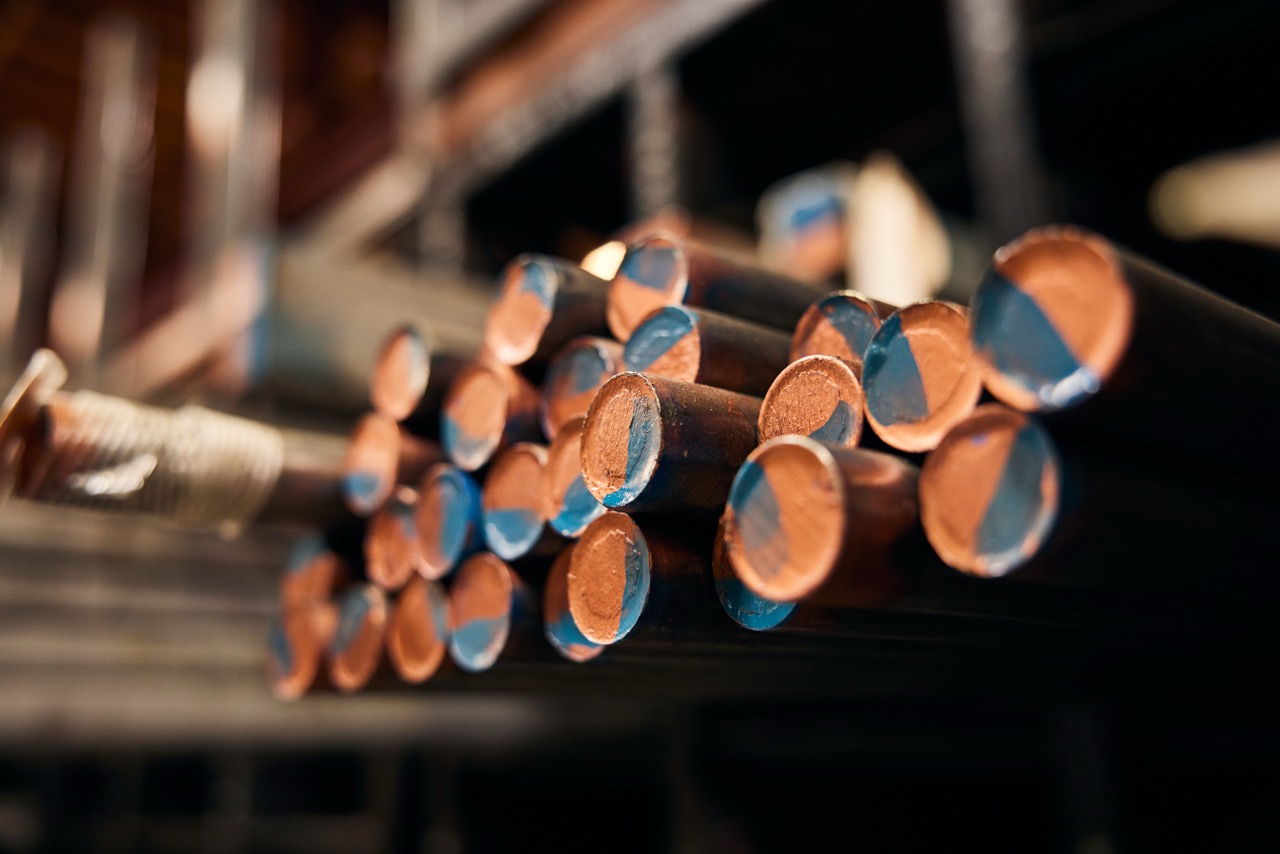
Choosing the right stainless steel alloy for your specific use is important, as every grade delivers varying levels of corrosion resistance, toughness, strength, machinability, and other factors. Precipitation hardening stainless steel is a clear choice for applications across aerospace, transportation, defense, and other industries.
In this PH stainless steel grades comparison, learn specifically about 15-5 PH and 13-8 MO, two types of martensitic PH stainless steel that offer significant benefits, certain tradeoffs, and ideal applications.
How Does Precipitation Hardening Work?
Precipitation hardening (PH) is a process through which stainless steel is heated, cooled, and aged to strengthen the material. Here’s what it entails:
- Solution treatment: The metal is heated to an extremely high temperature so that the alloying elements dissolve into one homogenous solution.
- Quenching: Then, the solution is cooled rapidly—known as quenching—so that the alloying elements remain in place in the metal’s crystal lattice.
- Aging: Finally, the solution is heated again slowly (at a lower temperature than during the solution treatment phase) so that the dissolved elements produce what are called precipitates.
The outcome of this solution-quenching-aging process is that, after aging, the tiny precipitates prevent movement in the crystal lattice and increase the steel’s tensile strength, or its ability to withstand stress when manipulated.
Both 15-5 PH and 13-8 MO undergo what’s called vacuum induction melting, which involves melting the steel in a special chamber using electromagnetic induction. This process (as opposed to traditional heating/cooling methods for materials like 440 stainless steel) produces a pure, chemically precise solution—necessary for high-performance applications.
What Do H-Designation Condition Codes Mean?
When researching different types of precipitation hardening stainless steel, you’ll come across H designation codes, such as H900, H1025, H1150, and so on, which indicate the heat treatment condition. So, a designation of H900 means that the metal was heated to 900 degrees before quenching. Different heat treatment conditions have different results, such as higher strength vs. more toughness and corrosion resistance.
What Is 15-5 PH Stainless Steel?
UNS designation: S15500
Primary AMS specifications: AMS 5659, AMS 5862, AMS 2300, AMS 2315, AMS-H-6875
15-5 PH stainless steel was developed as a more reliable, tougher, more fatigue resistant, and stronger alternative to 17-4 stainless steel, offering superior transverse toughness and forgeability. It’s used for aerospace structural and spacecraft components, preferred by manufacturers in commercial aerospace in California and beyond.
“15-5 PH” stands for 15% chromium, 5% nickel, and “precipitation hardening.” It also contains smaller amounts of other elements, including copper and iron.
The following are 15-5 PH stainless steel properties:
- Tensile strength: The tensile strength of 15-5 PH ranges from approximately 1,030 MPa to 1,310 MPa.
- Yield strength: Yield strength refers to the amount of stress that a material can withstand before permanently deforming. 15-5 PH stainless steel’s yield strength can range from about 930 MPa to 1,170 MPa. The exact tensile and yield strength of stainless steel depends on its treatment.
- Hardness: A metal’s hardness is measured using the Rockwell C scale, which ranges from 0 to 100, with 100 being the hardest material. The hardness of 15-5 PH typically ranges from C24 to C40.
- Corrosion resistance: 15-5 PH has good corrosion resistance due to its higher amount of chromium, inclusion of copper and iron, and precipitation hardening process.
- Machinability: Manufacturing precision parts is easier with 15-5 PH than some other metals, such as austenitic 300-series stainless steel.
- Weldability: 15-5 PH stainless steel is highly weldable, but it may be prone to cracking without proper control or heating it to the correct temperature.
What Is 13-8 MO Stainless Steel?
UNS designation: S13800
Primary AMS specifications: AMS 2300, AMS 5629, AMS 5864, AMS 5840
13-8 MO gets its name from the approximately 13% chromium, 8% nickel, and 2%–2.5% molybdenum (MO). Even though it doesn’t have PH in the name, 13-8 MO also undergoes precipitation hardening to enhance its properties:
- Tensile strength: 13-8 MO stainless steel can have a max tensile strength of approximately 1,515 MPa.
- Yield strength: Its yield strength can range from about 500 MPa to 1,450 MPa.
- Hardness: This type of PH stainless steel has a hardness range from approximately 32C to 48C.
- Corrosion resistance: While it’s typically not as corrosion resistant as, say, 316 stainless steel, 13-8 MO still has an excellent ability to withstand this type of environmental or chemical deterioration.
- Machinability: Because of its higher hardness measure, 13-8 MO isn’t as machinable as other types of precipitation hardening stainless steel, but certain treatments can make it easier to work with.
- Weldability: It has excellent weldability.
For 13-8 MO stainless steel, aerospace, defense, and nuclear industries are its primary applications due to its exceptional fracture toughness. This lends itself to the most demanding applications, such as jet engine and rocket components, high-pressure valves, and more.
Why Choose Fry Steel as Your Stocking Distributor
Providing a vast selection of precipitation hardening stainless steel, including 15-5 PH, 13-08 MO, and 17-4, Fry Steel is your California stainless steel supplier of choice. We offer not only a wide array of sizes and conditions but also the peace of mind that our materials and suppliers are certified through ISO 9001, AS9120, and AS9100D. Start a partnership with us today.