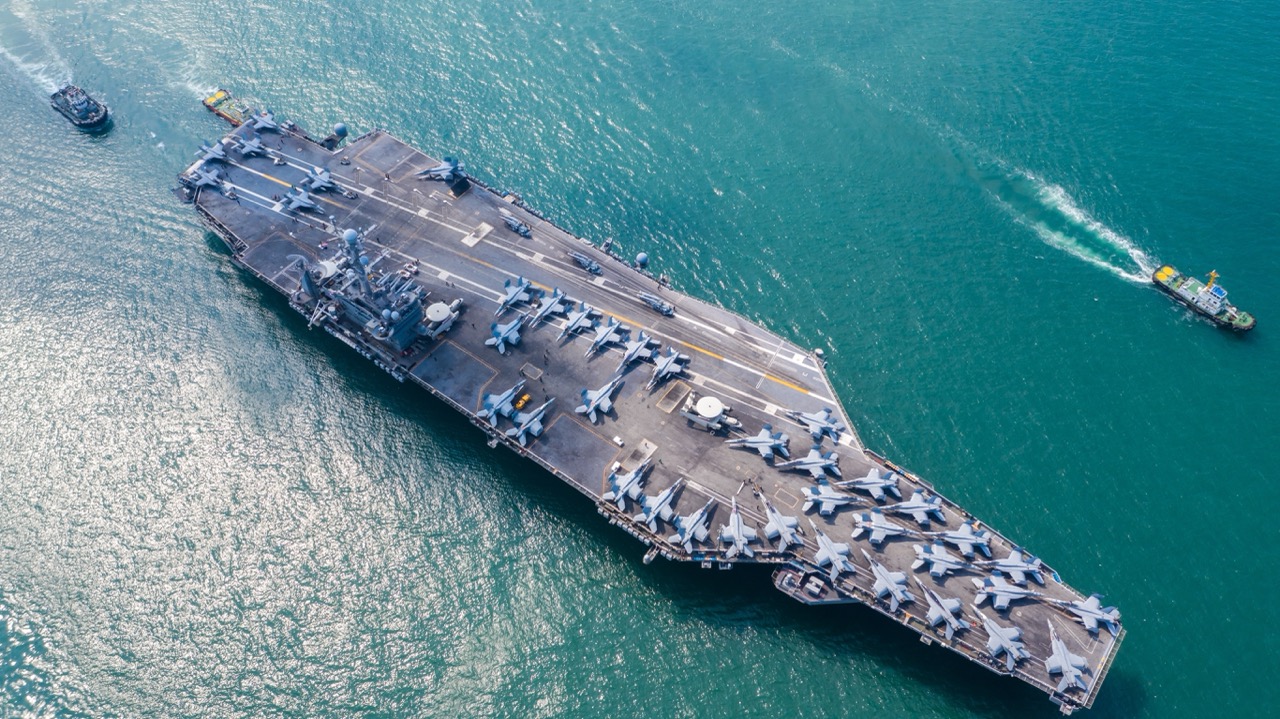
Naval manufacturing puts extreme demand on specialty metals. Ships and submarines operate in one of the most corrosive environments on earth, where opportunities for repairs and maintenance are not readily available. Materials used in these applications must be very strong, highly corrosion resistant, and extremely reliable.
Read on to learn more about naval shipbuilding metals and alloys. We’ll cover the components they’re used for, their unique properties, and the compliance standards they must uphold.
The Unique Demands of Naval Applications
Naval shipbuilding metals must be able to withstand 24/7 conditions that cause significant stress. Read on to learn more about the demands of naval applications.
Saltwater and Chloride-Induced Corrosion
Saltwater is an aggressive corrosive. The chlorides in salt water eat through stainless steel’s protective outer layer, making the material susceptible to pitting, cracking, and eventual failure. Many “corrosion resistant” metals that can withstand other conditions are unable to withstand saltwater.
Biofouling
Seawater isn’t just corrosive; it’s alive. Barnacles, algae, and other marine organisms attach to submerged ships, causing a range of issues. They trap moisture against the metals’ surface and produce corrosive byproducts that accelerate localized corrosion.
Extreme Pressure Cycling
Submarine and shipboard hydraulic systems are constantly pressurizing and depressurizing. Components must maintain dimensional integrity and fatigue resistance over millions of pressure cycles.
Regulatory Standards
Naval shipbuilding applications must meet a number of stringent regulatory standards to ensure their safety, traceability, and material makeup. These include:
- DFARS: This regulation defines where specialty metal can be sourced from. According to the DFARS Specialty Metal Regulation, they may only come from the U.S. or qualifying countries.
- MIL-SPEC: This is a traceability standard that defines specific manufacturing and testing requirements for machinery systems, Navy ships, and other marine applications.
- EAR/DPAS: The US Department of Commerce’s Defense Priorities and Allocations System (DPAS) and Export Administration Regulations (EAR) are designed to prioritize the use of defense metals for the production and safety of naval vessels and maritime equipment.
Nickel Alloys and Superalloys
Nickel alloys are among the best materials when corrosion resistance is a priority, as in naval applications. Its corrosion resistance far surpasses stainless steels, while providing comparable strength.
These materials are commonly used for:
- Pump shafts
- Valve components
- Propeller shafts
- Structural hardware
- Turbine hardware
- Exhaust hardware
The most common marine-grade nickel alloys for naval applications include:
- Nickel 400: A nickel-copper alloy with exceptional corrosion resistance when exposed to seawater and brine.
- Nickel 405: Nickel 400 with the addition of sulfur for easier machining. Choose Nickel 405 when complex cuts are required.
- K500: Nickel, copper, aluminium, and titanium make this a precipitation-hardened alloy. K500 is three times stronger than Nickel 400, with equal corrosion resistance.
- 718: Made of nickel, chromium, iron, and niobium for high temperature resistance above 1,200°F.
- 718 CR: Cold-reduced to increase strength and allow for tighter dimensional tolerances.
- A-286: Iron-based superalloy that is less expensive than 718 and temperature resistant up to 1,000°F.
Stainless Steel
Stainless steel is another widely used metal in naval shipbuilding. The addition of molybdenum makes stainless steel for shipbuilding more corrosion resistant than traditional steel.
Stainless steel is commonly used in:
- Piping
- Fittings
- Structural hardware
- Equipment supports
- Pump housing
- Internal components
Use these stainless steels for shipbuilding:
- 316L: This standard stainless steel contains 18% chromium and 8% nickel. It has good corrosion resistance and is easy to weld and machine, but doesn’t have enough corrosion resistance for saltwater.
- 316: 316L stainless with molybdenum to withstand corrosion from saltwater.
- 304: This stainless is used specifically for welding. It has a lower carbon content to provide sufficient corrosion resistance around welds.
- 17-4 PH: Copper, 17% chromium, and 4% nickel enable precipitation hardening and increase yield strength.
- 410 / 403: Iron with a 12% chromium content. Provides good wear resistance and hardness, but less corrosion resistance.
- 416: The addition of sulfur makes this material easier to machine than 410 and 403 stainless.
Aircraft Alloys
When maximum structural performance is the priority, aircraft alloys are the ideal naval shipbuilding metals. They are not corrosion resistant, so they require additional coatings to withstand saltwater.
In naval shipbuilding, aircraft alloys are used for:
- Gear housings
- Mechanical components
- Loadbearing hardware
- Launch and recovery equipment
- High-load assemblies
Two common grades of aircraft alloy are used in naval shipbuilding:
- 4140: Known as chromoly, this material contains iron, chromium, molybdenum, and carbon. It has high strength and toughness, as well as good machinability.
- 4340: Same as 4140 but with nickel added to improve toughness throughout the material, rather than just on the surface.
Source Marine Grade Alloys For Naval Applications From Fry Steel
With over 75 years of specialty metals experience, Fry Steel is your go-to naval metal supplier. We stock a full range of naval-grade alloys, engineered with precision and durability. We are a DFARS compliant naval metal supplier, and are certified in ISO 9001, AS9100, and AS9120. We hold our suppliers to the same rigorous quality standards. To get started, find a Fry Steel rep in your area today.