In the world of stainless steel, the most commonly used grades are 304 and 316 stainless steel. While both are stainless steel alloys, their unique chemical compositions provide differing benefits in terms of performance, longevity, and cost. Read on to learn the characteristics of each grade of stainless steel, their key differences, and how to select the best stainless steel for your application.
What is 304 Stainless Steel?
304 stainless steel, also known as 18/8 steel, is the most commonly used grade of austenitic stainless steel. It’s a steel alloy that’s composed of 18-20% chromium and 8-11% nickel. 304 stainless steel is commonly considered an “all-purpose” stainless steel due to its wide range of applications.
The acceptable chemical composition of 304 stainless steel is:
- Chromium: 18-20%
- Nickel: 8-11%
- Carbon: Less than .08%
- Silicon: Less than 1%
- Manganese: Less than 2%
- Phosphorus: Less than 0.45%
- Sulfur: Less than 0.03%
Key characteristics of 304 stainless steel include:
- High corrosion resistance: The addition of chromium to stainless steel boosts corrosion and oxidation resistance by creating a layer of chromium oxide on its surface.
- Excellent formability: Nickel lends stainless steel excellent formability and weldability, making manufacturing easy.
- Cost-effective: 304 stainless steel tends to be a more cost-effective stainless steel, resulting in a lower cost for the end consumer.
304 stainless steel is commonly used in a range of key industries, including:
- Medical: Surgical instruments, IV stands, hospital beds, pharmaceutical equipment
- Industrial: Fasteners, screws, machinery parts, piping, electrical enclosures, exhaust manifolds
- Food and Beverage: Kitchen equipment, pots and pans, commercial appliances, prep tables
What is 316 Stainless Steel?
316 stainless steel is also an austenitic steel alloy. It’s composed of 16-18% chromium, 10-12% nickel, and 2-3% molybdenum. 316 stainless steel is commonly used in high-stress environments like marine environments, chemical processing, and more.
The acceptable chemical composition of 316 stainless steel is:
- Chromium: 16-18%
- Nickel: 10-12%
- Molybdenum: 2-3%
- Manganese: Less than 2%
- Silicon: Less than 1%
- Phosphorus: Less than 1%
- Sulfur: Less than 1%
Key characteristics of 316 stainless steel include:
- Extreme corrosion resistance: Molybdenum boosts the corrosion resistance of 316 stainless steel significantly, offering protection from salt, acid, and other highly corrosive compounds.
- Very tough: 316 stainless steel is a very tough material even in extreme conditions like cryogenic temperatures.
- Stable at high temperatures: This stainless steel remains stable at temperatures up to 925° C.
316 stainless steel is a go-to choice for high stress environments due to its extreme stability and corrosion resistance. It’s commonly used in industries including:
- Marine: Off-shore structures, boat fittings, architectural applications near the coast
- Chemical processing: Manufacturing equipment, tanks, piping, particularly with highly corrosive chemicals
- Medical: Surgical tools, implants, medical equipment
- Industrial: Heat exchangers, machinery components, and other high-temperature environments
Differences Between 304 and 316 Stainless Steel
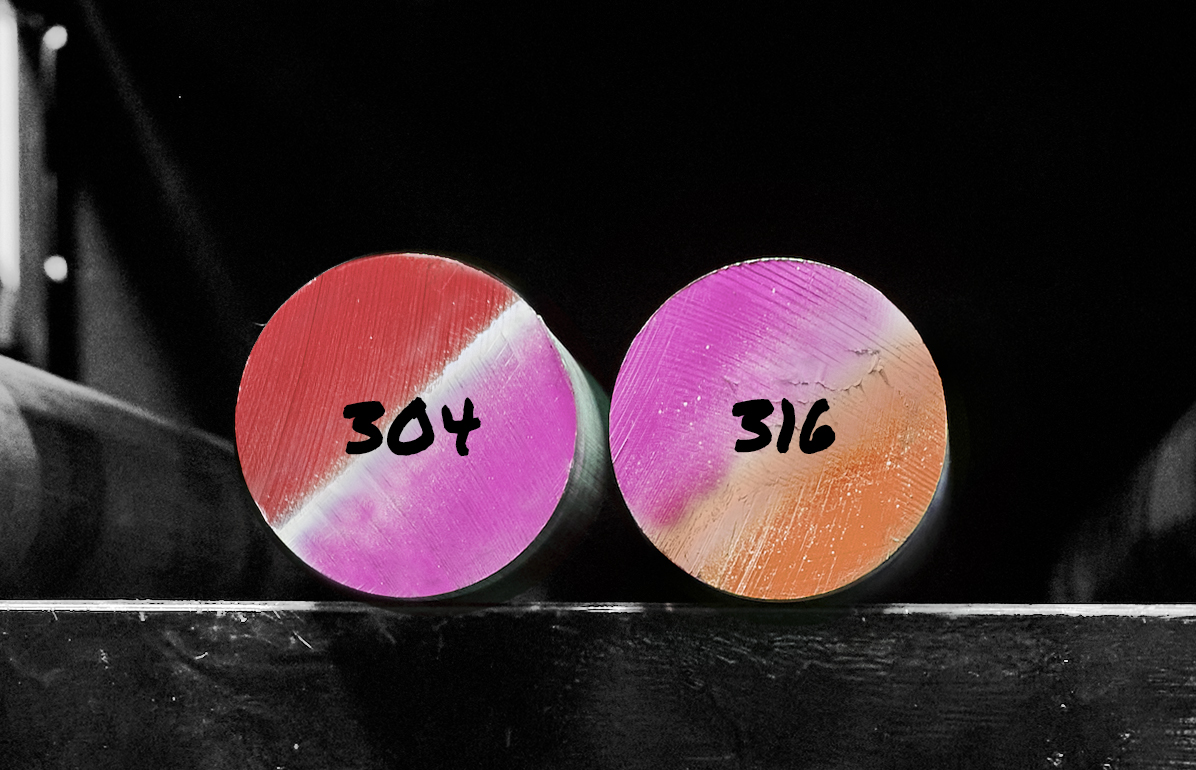
While 304 and 316 stainless steel are similar materials, they’re not identical. The key differences between 304 and 316 stainless steel include:
- Chemical composition: 316 stainless steel includes higher nickel content than 304 stainless steel and the addition of 2-3% molybdenum. It has a slightly lower chromium content.
- Corrosion resistance: The addition of molybdenum to 316 stainless steel significantly increases its corrosion existence. This makes it a better choice for highly corrosive environments with ongoing exposure to acids or salts, like chemical processing, marine environments, and more.
- Strength: 316 stainless steel is both stronger and harder than 304. This, too, improves its performance in extreme environments.
- Machinability: 304 tends to offer greater machinability and formability than 316 stainless steel.
- Cost: 316 steel tends to be 20-40% more extensive than 304 stainless steel, partially due to its more challenging machinability.
Choosing the Right Grade for Your Application
It’s easy to assume that greater strength and corrosion resistance is always better, but that isn’t the case. In many applications, the corrosion resistance and strength of 316 are simply unnecessary and therefore don’t justify its higher cost. Instead of defaulting to 316 stainless steel, consider these questions to choose the right grade:
- Environmental exposure: Will your part be exposed to marine environments or be used in highly corrosive applications?
- Lifespan: How long is your product expected to last?
- Regulatory requirements: Are there specific regulations surrounding the type of material your part requires?
Make a Confident Stainless Steel Selection with Fry Steel
Whether you’re looking for a reliable source for 304 and 316 stainless steel, or need guidance in choosing the best material for your needs, partner with Fry Steel. We have over 75 years experience supplying precision metals to manufacturers across the nation. Our regional experts bring in-depth knowledge and local expertise to elevate your manufacturing. Find a rep in your region today.