For more precise outcomes and more efficient processes, use centerless grinding. This high-precision finishing process improves dimensional accuracy, surface finish, and concentricity. When centerless grinding is integrated with your steel supplier, you’ll find even less variability, shorter lead times, and lower total cost.
Read on to learn all about centerless grinding: what it is, why it matters, and how to choose a metal supplier with centerless grinding services.
What is Centerless Grinding?
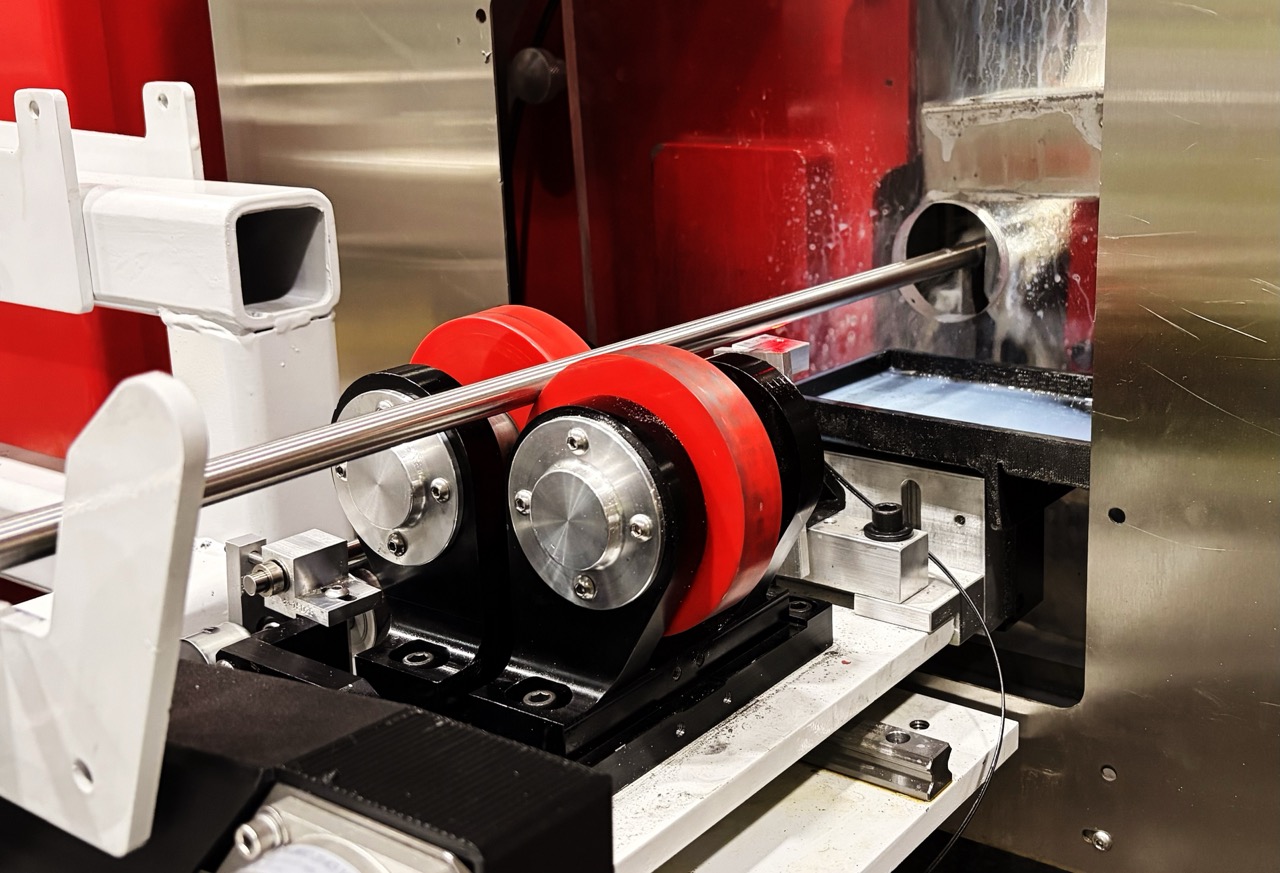
Centerless grinding is a grinding method for cylindrical parts that doesn’t require any centers or chucks. Instead, the part is placed on a work rest blade between two different wheels: a high-speed grinding wheel and low-speed regulating wheel. The grinding wheel grinds the part, while the regulating wheel controls the speed.
How it Differs From Traditional Grinding
Unlike traditional grinding, centerless grinding doesn’t require part centering. The part simply rests on the work blade rest. This allows for continuous grinding without the need to load and unload each piece. That said, traditional grinding offers greater flexibility for complex or multi-diameter parts than centerless grinding.
Types of Centerless Grinding
There are 3 different types of centerless grinding:
- Through-feed: Used for straight, cylindrical parts like pins and tubes. The entire workpiece passes between the grinding and regulating wheels.
- In-feed: Used for complex shapes or shapes with varying diameters. The workpiece is fed into the machine, then the regulating wheel puts it in contact with the grinding wheel.
- End-feed: Used for tapered parts. The workpiece passes between the grinding and regulating wheels until a certain point.
Benefits of Centerless Grinding
Centerless grinding improves dimensional accuracy, results in a better surface finish, enhances concentricity, and improves efficiency. Read on to learn how.
Tighter Dimensional Accuracy
Because it doesn’t require center holes, centerless grinding eliminates the risks associated with inaccurate centering. Similarly, the lack of clamps reduces the risk of axial thrust. This results in less distortion. Because the regulating wheel and work rest blade sit in the same place throughout the entire grinding process, tolerances end up more consistent .
Better Surface Finish
Centerless grinding creates much less deflection and vibration than traditional grinding. The part maintains consistent contact with the grinding wheel and regulating wheel throughout the entire process. This results in a smoother surface finish with superior roundness.
Enhanced Concentricity
The centerless grinding arrangement creates three points of contact with the part: the grinding wheel, the regulating wheel, and the work blade rest. This configuration grinds down the highest points of the surface first, until the entire surface is completely even. You’re left with a totally round part.
Greater Efficiency
Overall, centerless grinding is a much more efficient process than traditional grinding. There’s no need to manually clamp, center, or chuck the part before getting to work. It’s simply placed on the work blade rest and the job begins. Additionally, the process is continuous. The grinders never need to be loaded or unloaded; parts can just continuously feed through the centerless grinder.
Centerless grinding improves material efficiency, too. The process is exceptionally accurate, resulting in fewer mistakes and less scrap. ,
Why Choose a Metal Supplier with Integrated Centerless Grinding
Cut out the middleman by working with a metal supplier that processes materials, too. Metal suppliers with integrated centerless grinding services shorten lead times, lower costs, and boost consistency.
Shorter Lead Times
When you source your metal from metal suppliers without processing capabilities, lead times become extensive. You have to wait as your supplier ships your metal to a processor, who then processes your metal and ships it to you. As your metal passes from one set of hands to the next, you risk logistical errors and damage.
Instead, work with a supplier that processes in-house. They can supply and machine your metal in a single place, eliminating logistical steps and potential mistakes along the way.
Lower Total Cost
Fewer parties involved means lower costs, too. There’s no need to pay for transportation and logistics as you ship your raw materials from your supplier to your processor. Everything is simply done in-house.
Greater Production Consistency
When sourcing and processing happens under the same roof, you end up with greater consistency in your production. Materials are processed and inspected by the same source, so traceability is maintained throughout the process. For the best possible outcomes, work with a supplier who meets QMS certification standards like ISO 9001.
Fry Steel: Your Source for Raw Materials and Precision Centerless Grinding
Centerless grinding improves dimensional accuracy, surface finish, and machining efficiency. Fry Steel’s integrating centerless grinding services mean greater precision, shorter lead times, and consistent performance. For your best possible outcome, consult a Fry Steel rep early in your sourcing process. We’ll guide you toward the best materials for your final part. Find a Fry Steel location near you.